


Chris Nicholas
- @chrisgnicholas
- | he/him/it
Society for Conservation GIS



First and foremost, a HUGE THANK YOU!! to the Wildlabs team that put on a fabulous ICTC 2026 event in Lima ... the energy and diversity was amazing!
Secondly, a HUGE thank you to Amazon Conservation and Dan Nicholson for hosting a post-event field trip to the Los Amigos Field Station... WOW... to visit an intact rainforest was just amazing. The sounds of the forest! The stuff they catch in camera traps! They certainly are at the forefront of many things, with a full genetics lab, Microsoft Sparrow device, Starlink connectivity, etc.
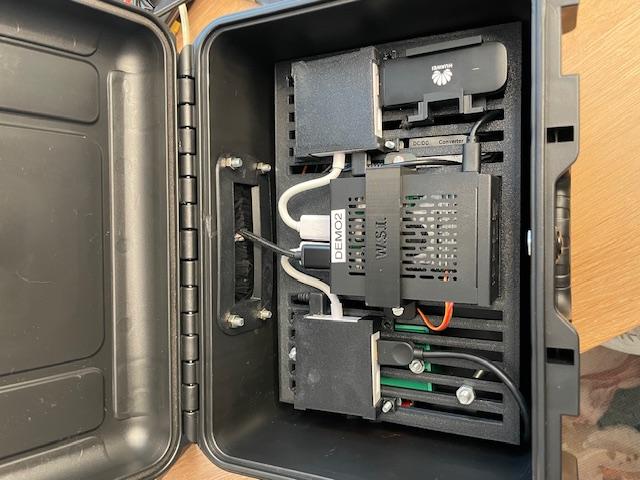
But even with Starlink capability, a few Audiomoths + drones + camera traps + ? easily overwhelm purely cloud-based compute models; there should to be a model of some local compute power+SSD storage (spinning disks die) for batch crunching, that can be securely managed from the other side of Starlink firewalls, via reverse-proxy NAT.
Has anyone else given some thought to a "standard" way of solving this problem? (besides Microsoft Sparrow people..)
Might the Sparrow people cooperate on such an effort?
vinyl_backup.pdf
23 March 2026 8:04am
I applaud the call for more computing on the edge ❤️ Our edge systems do indeed employ VPNs with reverse proxy to the edge. Our thermal wildlife camera does this, we can access the system anytime with live viewing, remote file retrieval etc (And we have a line of thermal imaging modules up to 1280x1024 resolution now :-) ).
One thing to consider though is that edge inference using a lot of power, let alone training. Assuming you were okay with the power, then the second thing is that if you were carrying our "extra" inference on batches on the edge, then that would cut into the available CPU for inference detection, which could result in trigger misses. For a Pi based platform this would be significant. However, some Jetsons platforms could realistically perform interfence triggering with good speeds as well as extra batch processing on the edge.
The Jetson platform is an amazing platform actually and when performing inference is also drawing a lot less power than a Pi performing inference. On the Jetson platform, in addition to triggering, we could easily performance edge inference on all the images of a burst of triggered capturing, without seriously impacting it's trigger inferencing.
Indeed, I think this is the way forward.








26 March 2026 10:42am
I don't know about a specific solution; however, I do link multiple computers together into a virtual network using TailScale.
Tailscale | Secure Connectivity for AI, IoT & Multi-Cloud
The connectivity platform for devs, IT, and security teams. Zero Trust identity-based access that deploys in minutes and scales to every resource. Start free.

Unless you're linking a lot of devices together, the free tier should meet your requirements.



20 April 2026 2:55am
Hi @chrisgnicholas It sounds like you are after more compute capability in remote field stations, rather than "edge computing" which is typically on the field device. This is something I have been pushing for locally, where an office or field station can have a hub where data is uploaded and the basic level of curation is undertaken. Then the data can be processed locally with a decent compute module / Jetson / laptop-with-GPU arrangement. For my work we don't need instant processing and feedback but reducing bandwidth use by filtering data with an AI model before it gets uploaded would be great.
I don't have a solution but just dropping to note that it would be a very useful addition to the workflows of monitoring and research orgs.
One use case I have been considering is to make a small server that is vehicle mounted, so that as SD Cards are collected they can be uploaded to a database or file storage. If the server had GPU/ai capacity the data could be processed and filtered before we returned to the office. A Jetson box on a reliable power source could conceivably do this for most of our data needs, or a gaming laptop would do just as well. They just need a few SD Card readers and automation scripts to handle the file transfers and start the processing queue. Food for thought.
Kim Hendrikse