
Camera traps have been a key part of the conservation toolkit for decades. Remotely triggered video or still cameras allow researchers and managers to monitor cryptic species, survey populations, and support enforcement responses by documenting illegal activities. Increasingly, machine learning is being implemented to automate the processing of data generated by camera traps.
A recent study published showed that, despite being well-established and widely used tools in conservation, progress in the development of camera traps has plateaued since the emergence of the modern model in the mid-2000s, leaving users struggling with many of the same issues they faced a decade ago. That manufacturer ratings have not improved over time, despite technological advancements, demonstrates the need for a new generation of innovative conservation camera traps. Join this group and explore existing efforts, established needs, and what next-generation camera traps might look like - including the integration of AI for data processing through initiatives like Wildlife Insights and Wild Me.
Group Highlights:
Our past Tech Tutors seasons featured multiple episodes for experienced and new camera trappers. How Do I Repair My Camera Traps? featured WILDLABS members Laure Joanny, Alistair Stewart, and Rob Appleby and featured many troubleshooting and DIY resources for common issues.
For camera trap users looking to incorporate machine learning into the data analysis process, Sara Beery's How do I get started using machine learning for my camera traps? is an incredible resource discussing the user-friendly tool MegaDetector.
And for those who are new to camera trapping, Marcella Kelly's How do I choose the right camera trap(s) based on interests, goals, and species? will help you make important decisions based on factors like species, environment, power, durability, and more.
Finally, for an in-depth conversation on camera trap hardware and software, check out the Camera Traps Virtual Meetup featuring Sara Beery, Roland Kays, and Sam Seccombe.
And while you're here, be sure to stop by the camera trap community's collaborative troubleshooting data bank, where we're compiling common problems with the goal of creating a consistent place to exchange tips and tricks!
Header photo: Stephanie O'Donnell
No showcases have been added to this group yet.

DIY electronics for behavioral field biology



- 8 Resources
- 98 Discussions
- 4 Groups

- @BarbaraFrancik
- | she/her
I am an early career researcher, particularly interested in animal behaviour and ecology. My previous experience is mostly in bioacoustics, and much of my work has focused on seabirds.
- 0 Resources
- 7 Discussions
- 5 Groups
- @CourtneyShuert
- | she/her
I am a behavioural ecologist and eco-physiologist interested in individual differences in marine mammals and other predators


- 0 Resources
- 13 Discussions
- 12 Groups

- 0 Resources
- 1 Discussions
- 7 Groups

I support humanitarian drone operations in the Global South, as well as ecology and conservation efforts utilising drones. I specialise in drone: Safety, Operations, Regulations, and Airspace Management


- 1 Resources
- 23 Discussions
- 22 Groups
Camera Trap Technologist at Large


- 2 Resources
- 47 Discussions
- 2 Groups
Fauna & Flora
Remote Sensing Scientist, Conservation Technology & Nature Markets


- 66 Resources
- 66 Discussions
- 12 Groups
- @Riley
- | she/they
I'm a Data Scientist at Western EcoSystems Technology. I am interested in AI processing and statistical modeling of acoustic data and camera trap and drone imagery.
- 3 Resources
- 5 Discussions
- 6 Groups
- @SenecaParkZooSociety
- | He, Him
Director of Conservation Advancement
- 0 Resources
- 0 Discussions
- 11 Groups

Worked as a mechanical engineer for a defence co, then software engineer, then for a research lab specialising in underwater robotics.


- 1 Resources
- 147 Discussions
- 16 Groups
- @LucyD
- | She/They
Backend engineer and data scientist with an ecology and conservation twist

- 0 Resources
- 3 Discussions
- 10 Groups

- @carlybatist
- | she/her
ecoacoustics, biodiversity monitoring, nature tech


- 133 Resources
- 373 Discussions
- 19 Groups
Careers
Consider applying if you have a passion for conservation, low-powered hardware, edge-AI, and embedded systems.
18 June 2026
Careers
Full Stack Developer - Conservation X Labs

Dante Wasmuht
Conservation X Labs is looking for an awesome Full-Stack Developer!
18 June 2026
Article
Practical Considerations for Camera Trap Photography
Robert (Bob) Zak
Trail Cameras & Custom Camera Traps: Technology, Ethics & Strategies for Success
12 June 2026
Careers
Biodiversity Monitoring Scientist

Tom August
This role would suit someone with a background in ecology or environmental science who enjoys combining fieldwork, data analysis, and applied research to support real-world environmental outcomes.
8 June 2026
Article
Wild Moves and Wild Album: New GBIF Data Portals for Animal Tracking and Camera Trap Data

WILDLABS Team and 1 more
New data portals are making it easier to discover and explore wildlife tracking and camera trap datasets from around the world.
4 June 2026
Article

Thanks to support from the WILDLABS Awards through the Boring Fund, funded by Arm, we were able to deliver a conservation technology training programme designed to make wildlife monitoring tools more accessible to rural...
3 June 2026
Careers
Ecologist (Postdoctoral Research Fellow), IS-0408-09

Lacey Hughey
The Smithsonian’s National Zoo & Conservation Biology Institute (in collaboration with Duke Farms, a center of the Doris Duke Foundation) is seeking a postdoctoral researcher to lead the development of next-gen...
1 June 2026
Article

🌍 Conservation technology is transforming how we protect wildlife, but are we thinking carefully enough about the risks? Drones, camera traps, GPS trackers, acoustic sensors, AI, and remote sensing have become...
22 May 2026
Careers

A 3-year, fully-funded PhD studentship at the interface of ecological theory, AI and global biodiversity mapping
28 April 2026
Article
Invitation to submit articles for a Special Issue of the journal "Sensors"
28 April 2026

Researchers at the University of Oxford are developing a software tool called MorphoCam to support workflows for camera trap distance sampling and morphometric measurements. Help shape the tool by taking part in this...
24 April 2026













May 2026
event

Ginevra Bellini
April 2026
event
Rebekka Stutz
63 Products
Recently updated products
4 Products
Recently updated products
| Description | Activity | Replies | Groups | Updated |
|---|---|---|---|---|
| I’m continuing to improve this project and would really appreciate feedback from anyone who can test it. Thank you to everyone who can help the workflow with this web app becomes... |
|
Data Management & Mobilisation, Camera Traps, Citizen Science | 3 hours 17 minutes ago | |
| Hi Bob,Thanks so much for that incredibly detailed reply! That is extremely useful. I will look into all of those cameras. Thanks for sharing your solution for the Browning... |
|
Camera Traps, Early Career | 4 hours 22 minutes ago | |
| Would love to talk. We build the AI model MiewID (currently v4.1) and Wildbook, which has been deployed for jaguars on Whiskerbook.org. Happy to share ideas. Data cleaning and... |
|
AI for Conservation, Camera Traps, Data Management & Mobilisation | 1 day 2 hours ago | |
| It’s worth considerig thermal cameras. They will see more, particularly small mammals at night. Here’s a Comparison of thermal and trail cameras. |
+7
|
Camera Traps, Animal Movement, Community Base, Early Career, East Africa Community, Emerging Tech, Human-Wildlife Coexistence | 1 day 20 hours ago | |
| I have tens of thousands of camera trap bycatch African mammal videos that are available for analysis to anyone who can turn them into published papers, data that is actually... |
|
AI for Conservation, Animal Movement, Camera Traps, Data Management & Mobilisation, Geospatial, Protected Area Management Tools, Sensors, Software Development | 2 days 6 hours ago | |
| Yes, there are quite a few SBCs that use SoCs with integrated NN acceleration. Except I think you are massively downplaying the advantages of the Raspberry Pi"plenty of... |
+23
|
AI for Conservation, Autonomous Camera Traps for Insects, Camera Traps, Edge Computing | 2 days 17 hours ago | |
| Hi everyone,I’m developing multilingual web tool that uses iNaturalist data to create visual wildlife reports/posters, with a focus... |
|
Camera Traps | 1 week ago | |
| Thank you for sharing. |
|
AI for Conservation, Camera Traps | 1 week ago | |
| Thank you so much Luke! |
+20
|
AI for Conservation, Camera Traps, Edge Computing | 1 week 5 days ago | |
| I can share some practical perspective on the LoRa camera trap architecture for remote high-relief terrain with poor connectivity.The core concept — cameras not connected to... |
|
Camera Traps | 1 week 5 days ago | |
| Thanks! 😀 The systems are currently in a place with Lynxes. Later this year some will move to a place with bears. |
|
Camera Traps | 2 weeks 4 days ago | |
| BTW. On my roadmap is to develop a very long distance IR system that could detect humans at 1km with reliably in complete darkness but I don't have the funding for it at the... |
|
Camera Traps, Wildlife Crime, Sensors | 3 weeks 4 days ago |













TrailCam - Browser tool for preparing trail camera observations
8 July 2026 12:44am
Camera Trap Suggestions for Time-lapse Seabird Monitoring?
9 July 2026 10:13pm
10 July 2026 11:35pm
Most trail cameras (rugged, small, weather resistant) have a “timelapse” mode, however, not all will do a full 24-hour timelapse of photos.
The factory firmware for the Browning trail cameras we use only allows timelapse during the day (after sunrise, before sunset).
I hacked the firmware on Browning Advantage, Edge, Elite HP4, and Elite HP5 ReconForce and SpecOps cameras so that they have an “All Day/Night” timelapse mode (including the flash at night). The PIR sensor is active even during timelapse, so the camera will also trigger on motion. If you don’t want this, you can put a piece of tape over the PIR sensor.
See: https://winterberrywildlife.ouroneacrefarm.com/2024/07/14/timelapse-feature-enhancements-for-browning-trail-cameras/
The firmware is available on my github site:
https://github.com/robertzak133/unified-btc-reverse
Note that my firmware does not work with later models HP5 (serial numbers starting 128 or greater), or with the new HP5-Ultra cameras. The latter has a new security feature which prevents this type of firmware hacking. So if you go down this path, you would need to find a source of earlier model cameras.
Alternatively, I am told that GardePro cameras offer an all-day/night timelapse mode right out of the box, but I have not tried this. In general, we find the image quality of the GP cameras to be lower than that of the Browning ReconForce/SpecOps models, but that may not be an issue for your project. In any case, you should check with vendor to make sure. See:
https://winterberrywildlife.ouroneacrefarm.com/2026/05/23/gardepro-a60-trail-camera-teardown-and-review/
You’ll have to experiment to find a timelapse frequency that will allow the batteries to cover your desired 72-hour target. For internal batteries, Li-Metal primary AA cells (e.g. Energizer Ultimate Lithium) are your best bet vs. other battery chemistries by something like a factor of two. On Browning cameras, operated through the night, you would probably need a frequency of 1 photo every 10 seconds, or perhaps every 30 seconds, to get through a continuous 72 hours on a set of 8 EUL AA cells. It will depend largely on duration of the night, due to the relatively higher energy required to operate the flashes. If you use an external battery, my firmware will take a photo every 1 second, max (factory firmware once after 5 seconds, max).
-bob
12 July 2026 5:03pm
Hi Bob,
Thanks so much for that incredibly detailed reply! That is extremely useful. I will look into all of those cameras. Thanks for sharing your solution for the Browning cameras.
Barbara
PantheraID: individual jaguar identification with computer vision, built from 14 years of camera trap data.
9 July 2026 5:39pm
11 July 2026 5:04pm
Would love to talk. We build the AI model MiewID (currently v4.1) and Wildbook, which has been deployed for jaguars on Whiskerbook.org. Happy to share ideas. Data cleaning and multispecies approaches to increase data volume and promote generalization are really the levers that have worked for us.
Camera trap recommendations
2 April 2026 11:40pm
6 June 2026 3:44am
Thank you everyone for your recommendations! We were awarded the grant, so I will share this information with our team, taking all your advice into consideration with our budget.
7 July 2026 1:20am
GP A60 Review is now up. See: https://winterberrywildlife.ouroneacrefarm.com/2026/05/23/gardepro-a60-trail-camera-teardown-and-review/

10 July 2026 10:22pm
It’s worth considerig thermal cameras. They will see more, particularly small mammals at night. Here’s a Comparison of thermal and trail cameras.
Getting behavioral data out of datasets that weren't built for it
16 June 2026 3:49pm
28 June 2026 10:12pm
This thread is exactly the conversation I was hoping to start - thank you all.
Janelle, your point about context is the crux of it. A crocodile with its mouth open could be thermoregulating, resting, or hunting, and the still frame alone won't tell you which - it's the surrounding signals (eyes, posture, what else is in the scene) that disambiguate. That's the whole problem in miniature: behavior isn't legible without context, and most datasets strip the context out. I love your reframe of observer bias as signal, too - the order in which individuals approach and explore a new camera is behavioral data, not just noise to wait out. And it points at exactly where I think this goes: no single stream is enough. Thermal, acoustic, eDNA, movement - layered together, you start to reconstruct a scene rather than just catalog detections.
Kim, the continuous thermal deployment you're describing is the kind of capture I'd love to understand better - sustained, passive, weatherproof is where the rare and off-frame behaviors actually live. Would be curious how much behavioral signal you're seeing in that data vs. presence/absence.
Henri, your bee work is striking - we're clearly circling the same core idea from different systems. I'd be glad to compare notes; I'll follow up directly.
More soon - this is the good stuff.
Maggie
4 July 2026 5:32pm
Here's a recent video of a Racoon dog and her young filmed at Lammi Biological Station recently.
I'd be interested to hear your review. How helpful is this for your behavioral use cases ?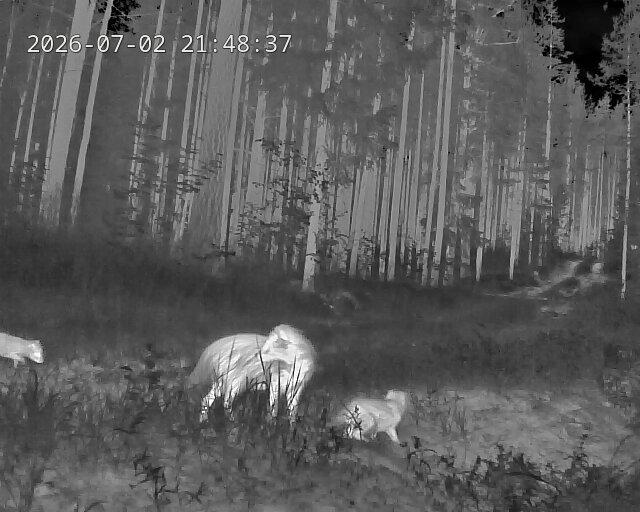
Below is the video link
https://youtu.be/G-pSfN1jqdc

10 July 2026 12:55pm
I have tens of thousands of camera trap bycatch African mammal videos that are available for analysis to anyone who can turn them into published papers, data that is actually useful for conservation, or publicity for wildlife and conservation.
They are already manually sorted into carnivores / herbivores and the carnivores are sorted and/or tagged to species. I do not have the resources to do anything further with them.
Mini AI Wildlife Monitor
25 June 2025 12:27pm
5 July 2026 5:19pm
Wow, what a great project.

8 July 2026 8:36pm
This is a great project! Some comments:
RaspberryPI though accessible is not the best fit for video pipelines and AI workloads or off grid deployments:
- it lacks onboard ISP which means either software implemented ISP, distorted data or on camera non energy optimized ISP.
- it lacks any power management techniques, low power modes, etc.
- it runs from SDCard using the same one for OS, swap and data, any corruption can lead to full loss.
- it runs any AI/ML workload on CPU which is extremely non efficient and any addon accelerators such as Hailo8 add a lot to power consumption and heat dissipation representing more challenges.
The advantages are of course plenty of documentation, community and all kind of makers addons, hats, etc.
For something more realistic, real life suitable I would suggest using something based on SoC with integrated NPU such as Hailo 15, Renesas RZ/V, Synaptics SL1680, MediaTek Genio or even the I.MX8M Plus for very light AI/ML workload. All of these have variety of SBCs, kits or even standalone smart camera oriented designs available from different vendors.
10 July 2026 1:32am
Yes, there are quite a few SBCs that use SoCs with integrated NN acceleration.
Except I think you are massively downplaying the advantages of the Raspberry Pi
"plenty of documentation, community and all kind of makers addons, hats, etc."
That is quite literally everything that makes the Raspberry Pi.
I've played with plenty of SBCs that are cheaper and have better specs than the Raspi, but they are almost useless because of the lack of "documentation, community and all kind of makers addons, hats, etc."
For a purpose built product by a team of engineers (with a lot of time and money behind them) then these SoCs with inbuilt NN are likely the future of this for of edge Ai deployment. But unless someone develops a well supported and well documented, general purpose device that uses one of these SoCs, then the default will still be the RasPi.
iNaturalist trail camera report tool — feedback welcome
5 July 2026 7:06pm
Building the perfect camera trap (Guide)
17 February 2025 8:06am
23 February 2025 8:11am
Hey Bob, thanks for the kind words! Your articles on Winterberry Wildlife have really been a big inspiration for me! There are extremely limited numbers of articles on trial cameras, and you have some nice in-depth hardware level which I have been reading 😊
You are completely right about the battery life and trigger speed tradeoff. If I remember right, there are a few cameras which offered “real time” images but in return the battery was drained in a few days and people started to complain on forums. In early stages of development there is also much about limiting the services at boot, as you mention putting the camera function as early in the boot sequence as possible, creating your own camera configs and so on.
29 June 2026 9:01pm
Great guide — this is exactly the kind of resource the community needs. A few additions from a hardware embedded perspective that might be worth including:
On PIR sensors — the standard Fresnel lens + PIR combination has a fundamental limitation in hot environments: when ambient temperature approaches body temperature (~35°C in African savannah), the thermal contrast between the animal and the background drops dramatically and trigger reliability degrades. This is worth calling out explicitly for tropical and arid deployments, where the standard PIR may miss animals during the hottest part of the day. Some teams have moved to passive radar (Doppler microwave) as an alternative trigger for hot environments — less species-selective but more temperature-independent.
On power architecture — one thing I'd add to the component deep-dive is the power switching circuit. Most commercial cameras use a simple battery holder with no protection. For DIY builds, a proper battery management IC with overcurrent protection, low-voltage cutoff, and reverse polarity protection adds almost no cost but prevents a lot of field failures, especially when using lithium primaries in extreme temperatures.
On IR illumination — the choice between 850nm (faint red glow, better image quality) and 940nm (truly invisible, lower image quality, shorter range) is well covered in most guides, but what's often missed is thermal management of the IR LEDs themselves. High-power IR LEDs run hot and can significantly raise the enclosure temperature in a sealed housing — worth mentioning as a factor in enclosure thermal design, particularly for cameras that run night-long video.
On the shift away from hardware — curious what drove that decision. Was it the enclosure/thermal challenges, the PIR reliability issue, or something else entirely?
5 July 2026 5:17pm
Thank you for sharing.
AI Edge Compute Based Wildlife Detection
23 February 2025 5:24am
30 June 2026 2:06am
I find the performance of micro-nano sized models that run on MCUs impractical for many applications. This is due to the low FPS, tiny Image resolution processed and very low model capacity.
I think people underestimate the huge jump in complexity from something working on the benchtop detecting a person from a meter away to trying to detect a cat-size object several meters away in a noisy environment.
30 June 2026 6:59am
Well stated Luca. Totally with you on this.

30 June 2026 2:04pm
Thank you so much Luke!
Cellular and Lora camera traps
20 May 2021 10:51am
24 May 2021 4:09pm
Hi Antoine,
I had not seen these before, but I'll echo Rob in wondering if the radio links in these are truly what most would consider 'LoRa'. That tech/protocol generally has very low data transfer rates and would be quite challenged in sending pictures. That said, what they call it may not be relevant if it works for you. I would just be cautious of thinking it could integrate with other 'LoRa' devices or networks. Some other web sites that mention this system describe the radio link as 'proprietary'.
Kyler
7 December 2021 4:51pm
Antoineede they are a mesh style of camera, one links to the other and then send pictures back to the home unit where you either send them via cellular or you check the sd card. The cover Lora and cuddielink cameras do this but they play hell on battieries.
I had a cuddelink system and got rid of it , the home unit was to hook up to a pc and then from there you could easily wept a scrip to send to txt message or email etc but they scrapped that idea
29 June 2026 8:57pm
I can share some practical perspective on the LoRa camera trap architecture for remote high-relief terrain with poor connectivity.
The core concept — cameras not connected to network, base station at a connectivity point relaying via LoRa — is sound and well-proven. A few things to consider for your specific conditions:
On LoRa range in strong relief — this is where the technology shines and where it disappoints unpredictably. In open terrain, 5-15km gateway range is achievable. In steep valleys or dense canopy, a node in a gully might only reach 200-300m. The solution is careful gateway placement on ridgelines or elevated points, and in complex terrain, one or two dedicated relay nodes at intermediate heights. Test before committing to a layout.
On reliability in heavy rain — LoRa itself is very robust in rain (the signal is largely unaffected by precipitation). The vulnerability is the hardware: connectors, antenna connections, and enclosures. For the gateway, use N-type or SMA connectors with proper weatherproofing, and position the enclosure under a simple rain shield. Cheap LoRa modules with U.FL connectors are more vulnerable — consider a fiberglass enclosed gateway with a proper outdoor antenna.
On the commercial options you mentioned — the Covert LoRa uses a proprietary LoRa implementation that requires their own base station, not standard LoRaWAN. This limits flexibility significantly. If you want to integrate with open platforms like The Things Network or ChirpStack and use standard sensors alongside the cameras, a system built on standard LoRaWAN is more future-proof even if it requires more initial setup.
Happy to discuss specific gateway options or architecture for your terrain.
Our first Lynx
19 June 2026 6:49pm

23 June 2026 6:00pm
Congratulations. The thermal images look great!

24 June 2026 12:19am
Woah!! Amazing videos. Super cool project!
24 June 2026 6:38am
Thanks! 😀 The systems are currently in a place with Lynxes. Later this year some will move to a place with bears.

Senior Hardware Product Development Engineer - Conservation X Labs
18 June 2026 4:42pm
Full Stack Developer - Conservation X Labs
18 June 2026 3:37pm
A thermal (at 1280x1024 resolution) impression of Kasteel park Born, The Netherlands
28 March 2026 10:50am
16 June 2026 3:21pm
Hi Kim,
I come from automotive CV where false positives around vulnerable road users are a constant challenge, especially with edge cases at night and in low-visibility conditions (in Greenland or Canada winter conditions might skew the video clarity).
I’m curious about how this is handled in conservation/anti-poaching setups, particularly in IR-based detection systems that can pick up humans at range in darkness.
In automotive we rarely try to classify object intent, rather just direction of movement and proximity, so I’m wondering how systems in your context avoid over-interpreting a detection (e.g. differentiating a hiker or worker from a genuine threat scenario), and what role something like restricted location, known poacher trails, activity, or time of day might play into interpreting the detection.
Is the system usually designed to be triggered based with a manual triage backend or if there might be some degree of automated triage? Or if the methods you use are mostly for animal detection a la camera traps and human detections are an added benefit?
Would be great to hear how you structure that pipeline in practice.
Thanks,
Ron
17 June 2026 7:45am
Great questions! Actually, I added AI object detection with large models to my system back in 2019, before I got involved in wildlife, it was for security purposes. I got involved in wildlife in 2023. I think the vast majority of wildlife users of AI are using very small models deployable on low power systems. So they would have many false positives and negatives I expect.
My systems have not yet been used for poacher detection. When I developed it for security, I needed to make it so reliable that I could have it wake me at night. So false positives and misses had to be very small. To that end I wrote the software so it could combine several other mitigating factors. Such as multiple modules at the same time, statistical based triggers etc. For example, we could make it detect a person requiring both a high confidence thermal match and a low confidence visible match in order to trigger. That sort of thing. It can be made very reliable.
I don't think you need to determine intent with the system. That can be left to the humans. So long as they can be notified. With our systems, in addition to getting the notification they can then come in live and view the situation from multiple camera actions. Very effective visibility is the key and rapid detection and clear notification. For my home security setup, I'm using yolov6 large model with inference on 1280x1280 images. The large model is a 140 million parameter model. It's very good with both recall and accuracy. I can't remember the last time any false detection woke me. And it never misses anything.
It also had from the very start a flexible state machine built in that can be menu configured to combine all kinds of state before it triggers.
(I'll find out about low visibility situations soon as I'll be deploying some thermal systems to Greenland next month).
17 June 2026 8:00am
BTW. On my roadmap is to develop a very long distance IR system that could detect humans at 1km with reliably in complete darkness but I don't have the funding for it at the moment. It would use a zoomable IR system with a 30-180mm thermal zoom at 1280x1024 resolution. It's kind of a dream system on mine and I'm determined to build it.
Safe and Sound project report: Is Camtrap DP a suitable standard for (bio)acoustic data?

18 March 2026 4:17pm

12 April 2026 6:19pm
Your report on extending Camtrap DP to bioacoustics resonated with something we are just beginning to explore in Mindoro Island, Philippines.
We have ongoing camera trap deployments in interior forest habitats and are beginning to examine the acoustic layer embedded in those recordings, particularly for nocturnal species such as the Mindoro Boobook. The discussion around terminology and how datasets are structured feels especially relevant, though I am still trying to understand how frameworks like Camtrap DP would apply in practice to this kind of data.
It is encouraging to see this direction being shaped at the community level. I will be following this closely as we continue to learn and figure out how our own datasets might eventually align.

15 June 2026 11:54pm
Thanks for this! I've shared this post with the WildTrax (https://wildtrax.ca/) team and CanAvian (https://canavian.ca/) to investigate. We're exploring data standards as part of a recent initiative so this will be very helpful! @jeffcullis
Issues with new model of wildlife cameras
8 June 2026 4:54pm

15 June 2026 12:19am
Hi Jennifer,
Reconyx are some of the best cameras, so it sounds like you may have been unlucky with the batch.
The 4 cameras you visited 2 months later (100% battery life) would appear to indicate that there's a trigger issue with the PIR, although you'd expect at least some drop in power even with 2 months idle consumption (1-2%). The 8/12 then running out of power with less than you'd expect photos wise however points to a possible brown out, which would be linked to battery chemistry if there's a pull of current and the camera is restarting in say 50% of the triggers, but you'd need some very old rechargable alkalines that have already been used for several years etc.
What did you use battery wise for the deployment?
If you sent them back for an inspection I would be interested to hear what the reason was.
Good luck!
Practical Considerations for Camera Trap Photography
12 June 2026 3:39am
Biodiversity Monitoring Scientist
8 June 2026 5:22pm
Wild Moves and Wild Album: New GBIF Data Portals for Animal Tracking and Camera Trap Data
WILDLABS Team
and 1 more
4 June 2026 6:36pm
What Happens When Conservation Technology Leaves the Lab? Lessons from Training Rural Communities in the Brazilian Cerrado
3 June 2026 1:20am
Ecologist (Postdoctoral Research Fellow), IS-0408-09
1 June 2026 4:02pm
Help shape best-practice guidance on conservation technology - input to survey
22 May 2026 10:20am
Call for Collaboration: Share your voice at ICTC next week!

11 February 2026 3:29am
19 February 2026 3:35am
Hi Anna!
Is there anything that sparks your curiosity, which I can address for you? Take a look at the upcoming day 2 and day 3 sessions, and if you see anything that intrigues you, please let me know! I'll happily join the session that aligns, and share your thoughts! ☺️
Kind regards,
Mandy
13 May 2026 2:18pm
That's a great idea @MandyEyrich ! Similar to your idea, I wrote up an article with geospatial highlights from ICTC 2026: https://wildlabs.net/en/article/wildlabs-geospatial-group-ictc-2026.
Is the Human-Wildlife Coexistence article available yet? Would love to read it and share it with colleagues at Fauna & Flora.
13 May 2026 2:21pm
@annavallery here's the article with geospatial-ish highlights in case you're interested: https://wildlabs.net/en/article/wildlabs-geospatial-group-ictc-2026. Let me know if you have any questions or specific interests. Happy to share further details!
Nature Tech Unconference - Anyone attending?
8 March 2025 12:11pm
24 April 2026 9:59am
What about this year? Who will be there?
https://www.naturetechweek.com/
I am planning to be there for the Unconference and some satellite events.
28 April 2026 4:10pm
I'll be there for the Unconference- looking forward to it!
13 May 2026 12:05pm
Myself and the Fauna & Flora Conservation Technology team will be there (@Chelsea_Smith and @ugyenpenjor ) and also the WILDLABS team @HRees ! See you!
Synchronizing camera traps

24 April 2026 12:45pm
2 May 2026 7:47am
I've looked into adding external triggers to camera traps. I've documented that effort here. Basically, it involves board level work to hijack the trigger signal. But as this signal is open drain, it's straightforward to wire-OR several of these signals from multiple cameras. In your case, you can perform this OR operation using simple wireless units.
I'm afraid I don't see a way to abstract and extract the trigger functionality cleanly into a drop-in product. Perhaps the best that can be done is to convert all participating cameras into slave units by replacing the IR sensor with a connector to which a master triggering source is attached. This still requires individual board work, but is at least straightforward.
3 May 2026 5:15pm
I guess I will need to come up with a timing requirement specifications. I am afraid that has to be done by trial and error.
3 May 2026 5:18pm
Your efforts looks interesting Harold! I will bring back some of the older cameras after this years field season for experimentation.
Looking for internships, fellowships, and scholarships in conservation technology
2 May 2026 9:03am
Biodiversity Lab Manager
Open PhD project: Decoding and mapping Earth's species interactions with ecological AI
28 April 2026 4:51pm
"Sensor Systems for Biodiversity and Ecosystem Monitoring" - Special Issue Invitation
28 April 2026 12:10pm

Calling all researchers working with camera trap imagery!
24 April 2026 2:03pm

12 July 2026 6:08pm
I’m continuing to improve this project and would really appreciate feedback from anyone who can test it. Thank you to everyone who can help the workflow with this web app becomes much faster and more efficient.
iNat TrailCam Local — V25