
Group curators
Tessa Rhinehart
- @tessa_rhinehart
- | she/her
University of Pittsburgh

Arky
Acoustic sensors enable efficient and non-invasive monitoring of a wide range of species, including many that are difficult to monitor in other ways. Although they were initially limited in application scope largely due to cost and hardware constraints, the development of low-cost, open-source models like the Audiomoth in recent years has increased access immensely and opened up new avenues of research. For example, some teams are using them to identify illicit human activities through the detection of associated sounds, like gunshots, vehicles, or chainsaws (e.g. OpenEars).
With this relatively novel dimension of wildlife monitoring rapidly advancing in both marine and terrestrial systems, it is crucial that we identify and share information about the utility and constraints of these sensors to inform efforts. A recent study identified advancements in hardware and machine learning applications, as well as early development of acoustic biodiversity indicators, as factors facilitating progress in the field. In terms of limitations, the authors highlight insufficient reference sound libraries, a lack of open-source audio processing tools, and a need for standardization of survey and analysis protocols. They also stress the importance of collaboration in moving forward, which is precisely what this group will aim to facilitate.
If you're new to acoustic monitoring and want to get up to speed on the basics, check out these beginner's resources and conversations from across the WILDLABS platform:
Three Resources for Beginners:
- Listening to Nature: The Emerging Field of Bioacoustics, Adam Welz
- Ecoacoustics and Biodiversity Monitoring, RSEC Journal
- Monitoring Ecosystems through Sound: The Present and Future of Passive Acoustics, Ella Browning and Rory Gibb
Three Forum Threads for Beginners:
- AudioMoth user guide | Tessa Rhinehart
- Audiomoth and Natterjack Monitoring (UK) | Stuart Newson
- Help with analysing bat recordings from Audiomoth | Carlos Abrahams
Three Tutorials for Beginners:
- "How do I perform automated recordings of bird assemblages?" | Carlos Abrahams, Tech Tutors
- "How do I scale up acoustic surveys with Audiomoths and automated processing?" | Tessa Rhinehart, Tech Tutors
- Acoustic Monitoring | David Watson, Ruby Lee, Andy Hill, and Dimitri Ponirakis, Virtual Meetups
Want to know more about acoustic monitoring and learn from experts in the WILDLABS community? Jump into the discussion in our Acoustics group!
Header image: Carly Batist
Group curators
- @tessa_rhinehart
- | she/her
University of Pittsburgh
Studying macroecology and conservation using bioacoustics


- 2 Resources
- 20 Discussions
- 3 Groups
Technologist and Visual storyteller focusing on social, conservations issues.

- 1 Resources
- 64 Discussions
- 17 Groups
No showcases have been added to this group yet.
Making hardware that solves problems

- 0 Resources
- 1 Discussions
- 12 Groups

Arribada Initiative
UX/UI Designer and Frontend Developer
- 0 Resources
- 0 Discussions
- 9 Groups
- @jkendallbar
- | she/her
Dr. Jessica Kendall-Bar is a Schmidt AI in Science Postdoctoral Fellow at Scripps Institution of Oceanography, UC San Diego. Her research combines engineering, data science, ecology, and visualization to measure behavior and physiology of marine animals amidst a changing climate.
- 0 Resources
- 2 Discussions
- 3 Groups

- @VMRocchi
- | Maxi
I am an Argentine biologist and a doctoral fellow at CONICET and APN, researching the conservation of Darwin’s frog. I have worked on biodiversity projects in Patagonia and Antarctica with frogs and marine mammals. Beyond my academic work, I am passionate about nature photography
- 0 Resources
- 3 Discussions
- 3 Groups

- @Dauson_M
- | Mr
Dauson Msumange is a social enterpreneur, founder and director of Tanzania Eco-Tech And Conservation Hub (TEACH).
- 0 Resources
- 1 Discussions
- 23 Groups

WILDLABS & Fauna & Flora
I'm the Platform and Community Support Project Officer at WILDLABS! Speak to me if you have any inquiries about using the WILDLABS Platform or AI for Conservation: Office Hours.



- 33 Resources
- 47 Discussions
- 2 Groups
Birding. Sound recording. Software tools for Bioacoustics. ML related to these subjects.
- 0 Resources
- 4 Discussions
- 2 Groups
- @jgaryi
- | She/her
Ecosonus
Researcher and co-founder of Ecosonus, a startup incubated at Harvard Innovation Labs that develops AI-powered tools combining bioacoustics, remote sensing, and geospatial modeling to monitor biodiversity.

- 4 Resources
- 4 Discussions
- 6 Groups

Software Developer (movebank.org, firetail.de)
- 0 Resources
- 3 Discussions
- 8 Groups

WILDLABS & Wildlife Conservation Society (WCS)
I'm the Bioacoustics Research Analyst at WILDLABS. I'm a marine biologist with particular interest in the acoustics behavior of cetaceans. I'm also a backend web developer, hoping to use technology to improve wildlife conservation efforts.


- 46 Resources
- 41 Discussions
- 34 Groups

- 0 Resources
- 0 Discussions
- 2 Groups

- @carlybatist
- | she/her
ecoacoustics, biodiversity monitoring, nature tech


- 133 Resources
- 373 Discussions
- 19 Groups
Article

Monitoring amphibians across the temperate forests of Patagonia presents significant logistical and technical challenges. Remote locations, harsh environmental conditions, and the large volumes of data generated by...
4 June 2026
Article

🌍 Conservation technology is transforming how we protect wildlife, but are we thinking carefully enough about the risks? Drones, camera traps, GPS trackers, acoustic sensors, AI, and remote sensing have become...
22 May 2026
Careers
A 3-year, fully-funded PhD studentship at the interface of ecological theory, AI and global biodiversity mapping
28 April 2026
Article
Invitation to submit articles for a Special Issue of the journal "Sensors"
28 April 2026
Careers
I'm looking for a new team member at the Australian Museum to advance machine learning techniques in species identification from bioacoustic data! 🐸 🎵
2 April 2026
Careers
The incumbent will join a research group led by Dr. Dena J. Clink to develop, evaluate, and apply quantitative methods for large-scale biodiversity monitoring and conservation.
19 March 2026
Article
Frontier Labs will be exhibiting at the ICTC 2026!

Frontier Labs Australia
Come find us at our booth, and don't miss our informative session talks!
6 February 2026
Article
Join the 2026 #Tech4Wildlife Challenge! (Feb. 2-6)

WILDLABS Team
For the 10th year in a row, we’re inviting the community to share photos and videos of how they’re engaging with technology for wildlife conservation. Participate to connect with the community, vote for your favorites,...
20 January 2026
Link
The 2025 study tested airborne eDNA, acoustic monitoring, manual surveys, and camera traps to detect birds and mammals in an agroforestry site in the Netherlands.
11 December 2025
Careers
PhD position in bioacoustics, statistics, and AI for forest biodiversity

Tim R. Hofmeester
We are hiring a fully-funded PhD student for four years to work on creating an automated open-source workflow from sensor to biodiversity metrics by applying (and perhaps further developing) deep learning models to...
11 December 2025
Article

The University of Hawai‘i - Ocean & Resources Engineering program is seeking project ideas from community groups, marine/ocean scientists, government agencies, companies, and non-governmental organizations for their...
16 November 2025
Article
Ecoacoustic Evidence

Carlos Abrahams
New Community-Driven Guide: Evidence-Based Guidance for Acoustic Survey and Monitoring
12 November 2025






June 2026
event

Wildlife Acoustics
event

Jaqueline Garcia-Yi
event
Wildlife Acoustics
September 2026

October 2026
May 2026
event
Jaqueline Garcia-Yi
event

Donovan Tye
April 2026
event
Jaqueline Garcia-Yi
March 2026
event
Diana Mastracci
67 Products
Recently updated products
| Description | Activity | Replies | Groups | Updated |
|---|---|---|---|---|
| Como dijo Carly, Audiomoths y Song Meter Micro, son los que mas te recomiendo. lo unico a tener en cuenta es que para audiomoths vas a tener que comprar o armar alguna especie de... |
|
Acoustics | 3 days 11 hours ago | |
| Hi everyone,I'm a student in Mexico studying engineering with a focus on conservation technology — working on IoT sensor networks, wildlife... |
|
Acoustics, Conservation Tech Training and Education, Latin America Community, East Africa Community, Connectivity, Marine Conservation, Camera Traps, Sustainable Fishing Challenges, Software Development, Data Management & Mobilisation, Protected Area Management Tools, Early Career, Sensors, Open Source Solutions, Emerging Tech | 1 month ago | |
| Global Conservation Tech & Drone Forum 2-6 March. Women in Conservation Forum 2 March. Hello all!I am the lead organiser of the... |
|
Acoustics, AI for Conservation, Citizen Science, Community Base, Conservation Tech Training and Education, Data Management & Mobilisation, Drones, Early Career, East Africa Community, Emerging Tech, Ending Wildlife Trafficking Online, Marine Conservation, Open Source Solutions, Protected Area Management Tools, Women in Conservation Tech Programme (WiCT) | 4 months 3 weeks ago | |
| Hi Luke, The local hardware is just a laptop and a few SIM routers.I guess the heart of it is the user experience, where the users can navigate their own choice of nature... |
|
Acoustics | 2 weeks 3 days ago | |
| Hi all!I'm an engineer in search of volunteer/paid work in conservation tech. I just graduated with my master's in mechanical engineering... |
|
Community Base, Acoustics, Animal Movement, Drones, eDNA & Genomics, Marine Conservation, Open Source Solutions, Sensors | 2 weeks 3 days ago | |
| Myself and the Fauna & Flora Conservation Technology team will be there (@Chelsea_Smith and @ugyenpenjor ) and also the WILDLABS team @HRees ! See you! |
+6
|
Geospatial, Acoustics, AI for Conservation, Camera Traps, Citizen Science, Community Base, Data Management & Mobilisation, Emerging Tech, Open Source Solutions, Protected Area Management Tools | 3 weeks 3 days ago | |
| cool! When you say: "...first usable result that validates our hardware and software signal chain." can you share what those chains are? As for connectivity, yeah, that'... |
|
Acoustics, Build Your Own Data Logger Community, Protected Area Management Tools, Sensors | 3 weeks 5 days ago | |
| At this point, I would suggest:- crosscheck with Alkaline Batteries (same sampling frequencies, same procedure)- change sampling frequency to see if the pulse repetition frequency... |
+13
|
Acoustics | 3 weeks 5 days ago | |
| Hey LeonardoI might have something. Lets chat, reach out to me at [email protected] |
|
Acoustics, AI for Conservation, Community Base, Drones, Funding and Finance, Open Source Solutions, Software Development | 1 month ago | |
| Hi Jose,You might be interested in BriteKit, which helps you build bioacoustic recognizers using deep learning. |
|
Acoustics | 1 month 1 week ago | |
| Hi Stephen, you should connect with the acoustic team at WildTrax (environmental sensor data management platform used across Canada)! They can definitely answer both of those... |
|
Acoustics | 1 month 1 week ago | |
| Hello!iNaturalist has been an exceptional citizen science platform, where its image classification model helps bridge the gap between... |
|
AI for Conservation, Acoustics, Citizen Science, Software Development | 1 month 2 weeks ago |




















Course on Fundamentals of Underwater Acoustics
5 June 2026 3:17pm
Open-Source Solutions for Amphibian Passive Acoustic Monitoring: Lessons from Patagonia
4 June 2026 4:57pm

Microphone Choices for Bird and Amphibian Bioacoustic Research
6 August 2024 12:56am

24 September 2024 3:25pm
Or you could use my sbts-aru project. Which is free software that runs on Raspberry Pis. It also allows you to perform sound localization remotely if required, without bringing the SD card back. Last night I had a listen to some calls in the jungle from Lajuma research center in South Africa that was recorded with them. @nlubcker and I expect to do some localization tests soon from the species down there.
If your Pi is connected to a network you can do localization in near real time (less than 10 minutes manually) as you don't have to stop the recorder or post process the recordings. If you write you own pipeline you can implement real-time sound localization with it and output a URL to a google maps location.
GitHub - hcfman/sbts-aru: Low cost Raspberry Pi sound localizing portable Autonomous Recording Unit (ARU)
Low cost Raspberry Pi sound localizing portable Autonomous Recording Unit (ARU) - hcfman/sbts-aru

My advice for microphones is the em272 microphone capsules based ones, which are very high quality microphones used as by the Swedish company Telinga in their parabolic microphones. That's what I use. They are very low noise and very sensitive. Here's a link to one, likely hard to get at your side of the world though.
Clippy EM272Z1 Mono Microphone - Veldshop
A clip-on lavalier microphone using the superb low noise, high sensitivity Primo EM272Z1 omni capsule.

In my testing they appeared to be similar in performance to some Rode clip microphones and similar in price. They are likely more easily obtained where you are.
3 June 2026 5:19pm
Como dijo Carly, Audiomoths y Song Meter Micro, son los que mas te recomiendo. lo unico a tener en cuenta es que para audiomoths vas a tener que comprar o armar alguna especie de cajita protectora. los de Wildlife acoustic, ya viene con protección, solo recomiendo hacer un "techo" con algun plastico.
Creating a classifier with Kaleidoscope + BirdNet for semi-automated frog identification (Intermediate level)
1 June 2026 1:22pm
Integrating BirdNET Analyzer & Kaleidoscope Pro
1 June 2026 1:20pm
Virtual Meeting June 2026 – Latin American WILDLABS Community
29 May 2026 2:10pm
Looking for internships, fellowships, and scholarships in conservation technology
2 May 2026 9:03am
Women in Conservation Forum: Monday 2nd March 2026 Nairobi
15 January 2026 7:21am
Help shape best-practice guidance on conservation technology - input to survey
22 May 2026 10:20am
Project Showcase: "Global Birdsong Radio" - A distributed edge-to-cloud acoustic sensor network using live streams
27 February 2026 1:00am
15 May 2026 1:24pm
This totally makes sense. All that effort deserves a reward, plus am sure the server plus AI costs are not cheap.

18 May 2026 4:48pm
This is really impressive Avi! Would you mind sharing what kind of hardware the local ingestion + detection is running on?
It's a fun experiment to think if this could be expanded to any live stream happening on any platform (Instagram, TikTok)
21 May 2026 12:10am
Hi Luke,
The local hardware is just a laptop and a few SIM routers.
I guess the heart of it is the user experience, where the users can navigate their own choice of nature real time stream mosaic.
Engineer Searching for Biologists
20 May 2026 3:18pm
Nature Tech Unconference - Anyone attending?
8 March 2025 12:11pm
24 April 2026 9:59am
What about this year? Who will be there?
https://www.naturetechweek.com/
I am planning to be there for the Unconference and some satellite events.
28 April 2026 4:10pm
I'll be there for the Unconference- looking forward to it!
13 May 2026 12:05pm
Myself and the Fauna & Flora Conservation Technology team will be there (@Chelsea_Smith and @ugyenpenjor ) and also the WILDLABS team @HRees ! See you!
Custom Hydrophone Records Dolphins
23 April 2026 3:33pm
3 May 2026 7:46am
Brett, you may reach out to @Lucille, who under the auspices of the Partnership for Observation of the Global Ocean (POGO), the Scientific Committee of Ocean Research (SCOR), and the International Quiet Ocean Experiment (IQOE) is managing the development of LC-MARE a low cost marine acoustic recorder. An ultra low power ADC is indeed an important component, so there may be some synergies.

6 May 2026 3:35pm
This is really interesting — especially the part about experimenting with different high-value uses.
I’m currently working on a small edge AI project for ecosystem monitoring, and it’s made me realize how different things can look outside of controlled environments.
Out of curiosity, during those experiments, what ended up being the biggest constraint — was it more about technical feasibility, cost, or something unexpected in real-world conditions?

11 May 2026 7:34pm
cool!
When you say: "...first usable result that validates our hardware and software signal chain." can you share what those chains are?
As for connectivity, yeah, that's a HUGE challenge ... Can you do SMS-level connectivity to Starlinks?
I presume you'd want to log basic temp/salinity, and perhaps include a basic accelerometer for wave motion over something like MQTT.
As for pushing down bioacoustic processing to the devices, yeah, would be awesome to do some minimal envelope threshold detection, and just send back compressed versions of 'the good stuff' . Maybe even listen for propellers and/or fishing sonar too, and send EarthRanger alerts.
And of course you'd want to do OTA updates, which in turn introduces security, etc.
Fun project!
Using rechargeable lithium-ion batteries for AudioMoths and/or Swift's
13 October 2021 5:32pm
22 April 2026 6:45am
Hi Everyone,
I have done some testing, and it seems like there is always some background noise from the switch, but it gets really loud once it echoes inside the Underwater case.
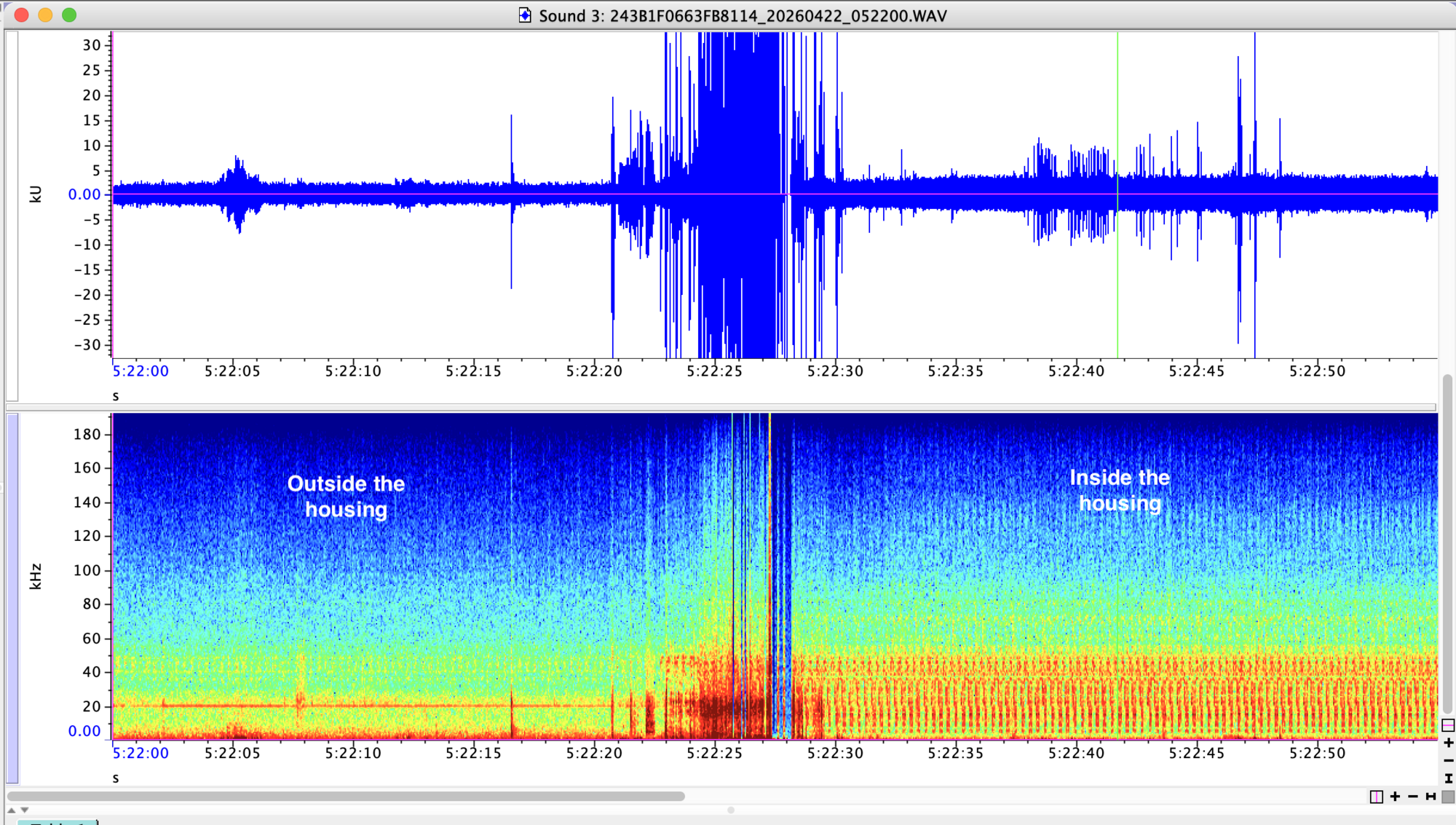
Please find all tests and comparisons of the XTAR CLR 4300, the XTAR 4150 and the Energizer Ultimate Lithium
https://drive.google.com/drive/folders/1Knbfk6A11YAdYtgn9k64ka7CU8tblw8-?usp=drive_link
Let me know if you have any suggestions and any extra tests to run.
The XTAR 4150mWh Capacity 2500mAh at the highest hydromoth settings runs only for 54 hours, which is not particularly impressive.
I also emailed XTAR for advice.
11 May 2026 6:56am
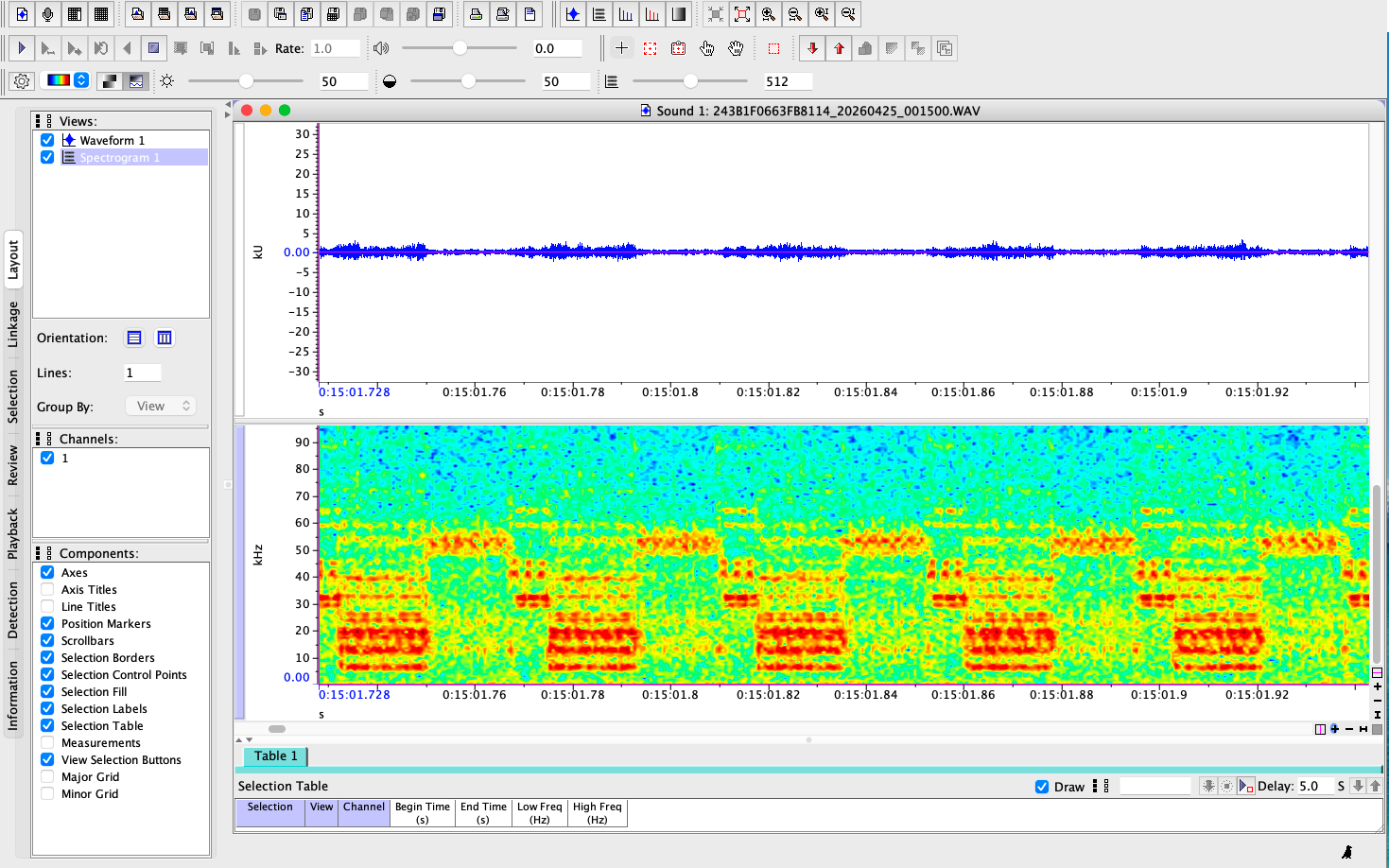
The XTAR CLR 4300 (2700mAh) lasted for 5 days and they still had power left, but they showed the same problem.
I have not heard back from XTAR.
Any suggestions?
I added the files in the Gdrive folder above.

11 May 2026 6:05pm
At this point, I would suggest:
- crosscheck with Alkaline Batteries (same sampling frequencies, same procedure)
- change sampling frequency to see if the pulse repetition frequency changes also or remains constant
Encuentro Virtual Mayo 2026 – Comunidad Latinoamericana Wildlabs
4 May 2026 11:15pm
Looking for opportunities in AI for Bioacoustics and Environmental Monitoring
6 April 2026 10:37am

8 April 2026 7:26pm
Hi I am also looking for collaborators

if interested in the project let me know
we can add acoustic monotoring for bees
17 April 2026 1:19pm
Hi Leonardo,
Let’s chat! I potentially have some opportunities, collaborations or even short-term employment. Send me a message.
1 May 2026 3:51pm
Open PhD project: Decoding and mapping Earth's species interactions with ecological AI
28 April 2026 4:51pm
"Sensor Systems for Biodiversity and Ecosystem Monitoring" - Special Issue Invitation
28 April 2026 12:10pm
What are the best Open-Source AI models for BioAcoustics?
12 October 2025 2:19pm
14 October 2025 3:25pm
Hi José,
BirdNET is one of the most common ones! The model is open, or there are also no-code interfaces that you can use as well.
Perch is another one (from Google hDeepMind) - good article about it too here.
The OpenSoundscape python package is also great for training your own CNNs.

9 January 2026 3:42pm
Hi Jose,
The links that Carly posted are great resources. Just adding a couple other no-coding-required options to this discussion:
PAMGuard is good for marine bioacoustic classification. It has classifiers already for many species that produce whistles and clicks. It can also be used to create custom classifiers. The program can have a steep learning curve so keep that in mind.
Arbimon is a cloud-based tool for data storage and bioacoustic classification. It has some existing classification models and can be used to create custom ones.
BirdNET Analyzer uses the BirdNET model with an easy to use GUI. Can be used as is or allows for custom classifiers using transfer learning from original BirdNET embeddings.
Cheers,
Jesse

23 April 2026 6:20pm
Hi Jose,
You might be interested in BriteKit, which helps you build bioacoustic recognizers using deep learning.
Data in the Data
3 April 2026 3:25pm
21 April 2026 2:44am
I recently was at the Los Amigos station, and just for fun turned on my Audiomoth at high frequency (~100khz) and got some crazy frog chorus recordings (along with bats and insects, etc) at a mosquito-infested pond in the Amazon. I too am indeed am looking for where to begin...
21 April 2026 10:19pm
Thanks folks
As I think about this more. I wonder how many ARUs also collect temperature data, as if I remember correctly, this modulates insects (crickets and grasshoppers), and maybe some frog calls (grey tree frogs in my area). We just ordered a couple ARUs but I dont think that temperature is recorded so I will need to zip tie a temp logger to it when we deploy them. Does anyone know if this is an issue that others have encountered?
Cheers
Stephen
23 April 2026 6:15pm
Hi Stephen, you should connect with the acoustic team at WildTrax (environmental sensor data management platform used across Canada)! They can definitely answer both of those questions. You could search the Data Discover portal (on WildTrax - https://portal.wildtrax.ca/discover) to see who has ARU recordings that might interest you. There is lots of open data on WildTrax.
You can also use tools like HawkEars to scan ARU recordings for hundreds of Canadian species, including amphibians (HawkEars is embedded in WildTrax, too): https://github.com/jhuus/HawkEars
Hope this is helpful!
iNaturalist Sound Classifier (browser extension)
22 April 2026 7:49pm
Spectrolipi - A tool for sound data annotation.
10 March 2026 4:10am

15 April 2026 9:34am
I joined today. I have a possible solution for your sparse problem - How H-ear Works | AI Sound Classification & Audio Annotation.
22 April 2026 10:59am
.
22 April 2026 11:06am
Hi Kristoffer,
I have tested upto 20 mins long sound files (48kHz /24 bit). It works without any significant lag on a normal office type machine (without dedicated GPU, etc). If required, I can try to provide a paging option which may be able to accomodate longer files.
Can you please inform the expected length of the sound files for your project.
Regards,
Nishant
New FishSounds Website Update!

5 April 2026 8:58pm

18 April 2026 2:55pm
Greetings Audrey, it is interesting to see to the project you are working on. If there's anything I can do to help with my skillset let me know.
Thanks, Mike
Kenyan Community-Led Mangrove Bioacoustics: Looking for Tips & Collaborators
14 November 2025 10:38am
6 April 2026 10:31am
Hi Fatin,
this sounds very interesting. I am an AI engineer and I just finished a job where i developed an AI model for audio classification and deployed it on an AudioMoth. Please let me know if you are interested in any kind of help or collaboration!
Leonardo
14 April 2026 1:04pm
Hi Leonardo,
thank you for your interest to help in classification.
I'm working with Fatin in this project, kindly reach out to us via email so that we can share more about the project; [email protected] cc [email protected] .
Thank you 🙏
18 April 2026 2:49pm
Greetings Nurfatin, it is interesting to see to the project you are working on. If there's anything I can do to help with my skillset let me know.
Thanks, Mike
Transfer learning with BirdNet for avian and non-avian detections

23 February 2025 12:18pm
2 April 2026 2:53pm
Hi, I am trying to identify caimans' sounds. A friend of mine is trying to identify primates' sounds in South America.
6 April 2026 10:33am
Hi Danielle,
I haven’t trained BirdNET directly, but I recently worked on a multi-species bird classification project using custom labeled datasets.
In our workflow we trained lightweight models using data augmentation and knowledge distillation from larger models, with the goal of making the system suitable for deployment on low-power devices like AudioMoth.
I’d be very interested to hear about others’ experiences adapting BirdNET to new taxa, especially bats or insects.

17 April 2026 2:57pm
Just now seeing this - so apologies for the late reply! We studied multiple different bioacoustics embedding models (including BirdNet v2.3) for transfer learning performance for underwater and marine mammal tasks. The BirdNet version we examined had solid performance alongside Perch 1.0 and 2.0 models on the tasks we evaluated (see: paper - Perch 2.0 transfers 'whale' to underwater tasks and blog post for more details). For example code - we have this end-to-end colab demo for an agile modeling workflow to create custom classifiers where there are multiple embedding model options to choose from (including BirdNet). Hope this helps!
Safe and Sound project report: Is Camtrap DP a suitable standard for (bio)acoustic data?

18 March 2026 4:17pm

12 April 2026 6:19pm
Your report on extending Camtrap DP to bioacoustics resonated with something we are just beginning to explore in Mindoro Island, Philippines.
We have ongoing camera trap deployments in interior forest habitats and are beginning to examine the acoustic layer embedded in those recordings, particularly for nocturnal species such as the Mindoro Boobook. The discussion around terminology and how datasets are structured feels especially relevant, though I am still trying to understand how frameworks like Camtrap DP would apply in practice to this kind of data.
It is encouraging to see this direction being shaped at the community level. I will be following this closely as we continue to learn and figure out how our own datasets might eventually align.
7 August 2024 8:02pm
Thank you so much for the thoughtful reply Carly - this was incredibly helpful.